Ask walleye anglers when the fish feed in the fall and you will hear the same answer: dusk, dark, and dawn. That advice is old, and it is usually explained with one line about "low light." For one Ontario lake we can say more. Lake Simcoe has been sampled since 1980, and the province publishes the readings. They show what the water itself was doing in September, October and November, and they point to three things that could stack up in the same direction: oxygen, turnover and clarity.
This article walks through those numbers, says exactly where each one holds, and is honest about the step the data cannot make: the monitoring program measured water, not walleye.
The data, and its limits
The Ontario Lake Simcoe Monitoring program recorded temperature and dissolved oxygen at depth, plus Secchi depth (how far down a white disc stays visible), at 15 stations from 1980 to 2024. We used the published files directly: about 105,500 temperature-and-oxygen readings and 5,836 Secchi readings.
Two cautions apply to every number below.
- The stations are not spread evenly. About 55% of the temperature-and-oxygen readings come from just three stations, all in the deep water of Kempenfelt Bay (K39, K42 and K45; 36 to 43 m deep). An unweighted "whole-lake" figure is really a deep-basin figure, so we split the lake by station depth wherever it matters.
- Counts are readings, not independent events. One sampling trip produces a column of readings at 1 m steps, so "3,150 readings" does not mean 3,150 separate low-oxygen episodes.
Step 1: In September and October, the deep water runs short of oxygen
During summer stratification, a warm surface layer sits over a cold bottom layer, and the bottom layer cannot take in oxygen from the air. Through late summer it is used up.
Counting readings at 10 m or deeper with dissolved oxygen under 5 mg/L (a low-oxygen mark; tolerance varies by species), across all stations and years:
- August: 1,141 readings
- September: 3,150 readings
- October: 1,898 readings
- November: 26 readings
The problem peaks in September, is still large in October, and is nearly gone by November. Readings under 3 mg/L follow the same shape (1,098 in September, 789 in October).
This is a Kempenfelt Bay story, not a whole-lake story. For September and October readings at 10 m or deeper:
- Deep stations (30 m or more): median 6.2 mg/L, and 35% of readings below 5 mg/L (n = 12,841).
- Shallow stations (under 20 m, main basin and eastern side): median 8.5 mg/L, and 9% below 5 mg/L (n = 1,540).
Lake Simcoe behaves like two lakes. The deep arm stratifies firmly and goes oxygen-poor at depth. The big shallow basin mixes again and again whenever the wind blows, so it never builds a durable low-oxygen layer. Anything said below about "the deep water running short of oxygen" applies to the deep basin only.
How high up does it reach? Looking at each September and October profile at the three Kempenfelt stations (498 profiles, our own tally), 372 had at least one reading under 5 mg/L. In September the shallowest such reading sat at a median depth of 18 m; in October, 26 m.
Step 2: Turnover is mostly an October event
Fall turnover is when the surface cools until the whole water column is close to one temperature and wind can mix it top to bottom (this is the textbook behaviour of lakes like Simcoe that freeze over in winter). It is why the low-oxygen layer disappears.
The data shows it happening. Averaging surface-to-bottom temperature differences over profiles at least 8 m deep (n = 592 for October):
- July: about 9°C between surface and bottom
- September: 5.7°C
- October: 1.9°C
- November: 0.3°C
So the lake is mid-turnover in October and fully mixed by November, which matches the oxygen counts above. Once mixed, oxygen is no longer a limit on where fish can be. At the three Kempenfelt stations, the November median at 10 m or deeper is 10.0 mg/L (n = 1,831).
Note what this means for the "fall bite." Oxygen shapes where fish can sit in September and October in the deep basin. By late November it does not, so whatever drives behaviour then has to be something else. Light is the obvious candidate.
Step 3: The lake is clearer than it was, and light goes deeper
Secchi depth is a simple clarity measure, and water clarity sets how far daylight reaches. Medians across all stations:
- 1980-84: 3.3 m (n = 458)
- 2005-14: 5.5 m (n = 1,580)
- 2020-24: 4.5 m (n = 529)
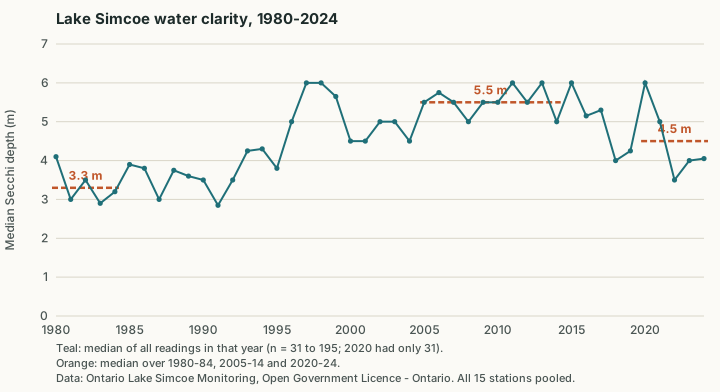
Clarity roughly improved by two thirds and has since slipped back part of the way. The figures show the change itself, not its cause.
Two details. Pooling stations includes murky shallow bays, which pulls the median down. Using only the three deep Kempenfelt stations gives 4.1 m, 7.0 m and 6.5 m for the same three periods. The direction is the same, and bigger.
What does clearer water do? A common approximation treats light as fading with depth at a rate inversely proportional to Secchi depth. If so, any particular light level sits deeper in proportion. With the 2020-24 median of 4.5 m against 3.3 m in the early 1980s, a given dim light level sits about 1.4 times deeper than it used to, and about 1.7 times deeper at the 2005-14 peak. That is simple arithmetic on an approximation, not a measurement of the light itself. An illustration: a level found at 10 m in 1980-84 would be near 14 m in 2020-24.
Putting the three together
Here is the chain, with each link marked by what we know and what we are inferring.
- Measured: in the deep basin, 18 to 26 m is where oxygen starts to fall under 5 mg/L in September and October.
- Measured: the lake is clearer than in the 1980s, so daylight reaches deeper than it used to.
- Reported by fisheries agencies: walleye feed best in low light. Iowa's Department of Natural Resources says walleye have a light-gathering layer in the eye, the tapetum lucidum, that lets them see well in low light, "giving them an advantage over prey fish." That is a general statement about the species, not a study of Simcoe fish.
- Inference: a walleye that prefers dim light and also needs oxygen has a narrower daytime window in the deep basin than it would in a murkier or better-oxygenated lake: the light-matched depth is pushed down toward the oxygen-poor layer. After dark, that light-matched depth rises, into water with plenty of oxygen.
The fourth step is a hypothesis. Nobody in this dataset tagged walleye or counted them by depth. The fisheries source supports the preference for low light; the oxygen and clarity numbers show the constraint is real in the deep basin. Whether it settles where walleye actually are in Kempenfelt Bay on a given October afternoon is untested here.
It also does not carry over to the rest of the lake. In the main and eastern basins the same September and October readings are mostly well-oxygenated, so low oxygen is not a good explanation for fish behaviour there. Light and temperature may still matter, but the oxygen argument does not.
What anglers say, and what we are not claiming
Anglers commonly report that November walleye bites cluster around dusk and dark, and that the first and last hour of light are worth the effort. That fits the picture above, and it fits the agency description of crepuscular feeding. It is not a schedule. We are not giving a time-of-day chart or any odds of a hookup: the data cannot support either, and light, wind, water temperature and lake-to-lake differences move the picture each year.
Practical takeaways that follow from the evidence, not from folklore:
- If you fish the deep arm of Simcoe in September and October, expect depth to be constrained by oxygen as well as temperature, and expect that constraint to lift as turnover finishes.
- On other lakes, clarity matters. Check roughly how clear the water is, because the same light level sits deeper in clear water.
- Night fishing from shore or a small boat means cold water and little light. Tell someone where you are going, wear a lifejacket in a boat, and scout the spot in daylight.
Before you go: check the rules
Walleye seasons and size limits are set zone by zone, and some zones close earlier in the fall than others. Lake Simcoe is in Fisheries Management Zone 16; see our FMZ 16 walleye and bass season guide. If you fish elsewhere, start from the guides index and confirm your zone, plus any exceptions for a specific waterbody. The official Ontario fishing regulations summary is the authority if anything here disagrees with it.
Data: Ontario Lake Simcoe Monitoring, 1980-2024, used under the Open Government Licence - Ontario. All counts and medians were recomputed by Backlash Journal from the published files.